Wandering Book Man
(1) – South-East Asia
It is always interesting to note how one’s profession
operates overseas. My first such encounter was during a short time I spent in South-East Asia. My perspective was very much that of an
outsider, meeting seller’s focused on serving the tourist market. Native
language booksellers of course exist in that part of the world, although I did
not encounter any, and their presence is certainly muted compared with the
apparently thriving tourist market.
Although
my travels began in Thailand,
it was not until entering Cambodia
that the evidence of a significant tourist-driven book trade became prominent.
Anyone who has visited Siem Reap and the nearby remains of the fascinating Angkor kingdom will be well acquainted with the army of
street sellers who lurk at both entrances and exits of all the major sites. The
merchandise on offer is always more or less the same. I have no idea of the
specific working conditions and relations of these sellers. It is quite clearly a precarious and often
demeaning existence, and I would guess fairly confidently that the sellers
themselves have little stake in the goods they are selling.
Books
are not the main stay of the traders who seek shade around the outskirts of the
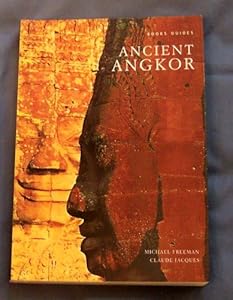
glorious temple complexes. But one book in particular is ubiquitous, Claude
Jacques’
Ancient Angkor. I think in
the three days spent exploring the various temples it must have been offered to
me over fifty times. The minute you arrive, the first seller able to latch on
to your crowd appears so keen not to allow others the opportunity to make their
pitch, that the price falls remarkably and near continuously if you decline to
make the purchase. Now I check to see the book’s availability online it appears
it may have been worth me buying up several at these basement prices. The high
competition amongst sellers also generates some interesting sale techniques. My
particular favourite was a Cambodian who had evidently perfected an Australian
twang and proclaimed “Wanna buy my book mate?” as we passed.
There
is one distinct aspect to the sellers around Angkor that sets them apart from
most street book sellers in South-East Asia.
They actually sell original copies of the book. The booming trade elsewhere is
sustained by cheaply produced photocopies of various standard works. In clear
disdain for any copyright laws these bootleg books are sold freely and
publicly. As would be expected from such a venture, the quality of the final
product is very varied. All show the clear signs of photocopied reproduction
and budget binding. Some have unreadable passages, others are misbound with
pages absent or out of place, and the text block is never squarely justified.
If you do wish to buy a decent inspection of the text is essential. Although most
sellers seem to keep their books in plastic wallets I never encountered one who
refused their prospective buyer a browse prior to purchase. The lower quality is
reflected in the sale price, although this too is highly variable and often
seems subject to the seller’s appraisal of his client. Whilst in South America I was informed by one tout that the
practice was to always begin negotiations at double the standard start rate
when dealing with Japanese tourists. I’m sure the specifics are different in South-East Asia, but the same general rule applies. The
tight fisted can always get a bargain, even if it means initially walking away
from the negotiation. Although a high start price can create the illusion of a
bargain, so it is always best to shop around if you are really concerned about
the best price, which most Western tourists to South-East
Asia are unlikely to be, given our purchasing power there.
That
being said, original authentically published English-language books are
generally not cheap. The prices in the few new bookshops geared to tourists I
came across would not have seemed out of place in Britain. Not enough to deter many
perhaps, but certainly an encouragement for the budget backpacker to buy
bootleg.
Crossing
the border into Vietnam
I encountered a new phenomena. Whilst my experience of Cambodian book
bootleggers was as market stallholders, more common to Vietnam was the
roaming salesman precariously balancing a mountainous pile of books on their
forearm. Yet this was not the most daring balancing act I was to witness in Vietnam. From a
large gas canister resting unhinged on the back of a speeding motorbike, to a
cyclist with boxes piled high in his front basket obscuring all vision of the
road ahead. Still I can certainly be thankful my work does not require me to
carry my wares all day long.
Being constantly
pestered to consume is an unfortunate by-product of any visit to Ho Chi Minh City and I
can understand the temptation of many a frustrated tourist requesting a perusal
of a title sitting dangerously near the bottom of a sellers’ book mound in hope
perhaps of causing a cascade rather than locating a new read. A futile hope,
for this is an art well perfected by the street sellers.
I got
into conversation with one seller whilst browsing his selection and mentioned
that I too was a bookseller. He showed little interest and in truth was right
to recognise little commonality. I did not pry into the details of his working
conditions but it seems highly likely that he and others like him receive only
a fraction of the agreed sale price. Whilst I have grievances with the amount
of money that goes to ABE each time I sell a book through their site it could
hardly be considered a similar relationship.
The
selection of books on offer varies little between sellers but includes much of
interest, particularly for those with an interest in the history of the region.
They offered a good range of titles on the Vietnam War, the Khmer Rouge and the
Angkor civilisation, although little on less
prominent periods of regional history. Whilst mostly authored by Westerners
there were a few titles written by Cambodians and Vietnamese, for the most part
first hand accounts of either the war, or life under the Khmer Rouge. All
manner of perspectives are on sale, although those with an anti-imperialistic bent
prevail. Not all the books they sell are cheaply available online. I purchased
a copy of People’s War, People’s Army.
The Viet Cong Insurrection Manual for Underdeveloped Countries by General
Vo Nguyen Giap of the Vietnam People’s Army to read for what equated to
approximately £1, and after returning home was able to sell it as a poor photocopy
reproduction for £5, half the price of the next cheapest copy and a fifth of
the price of the cheapest copy in Britain. Hardly the route to a fortune, but
nevertheless indicative of the online worth of some of the books on offer.
There is of course an ethical criticism of bootlegging, which I reject, but
will perhaps save discussion of that for another piece.